
NTIA Administrator Arielle Roth Announces BEAD Savings
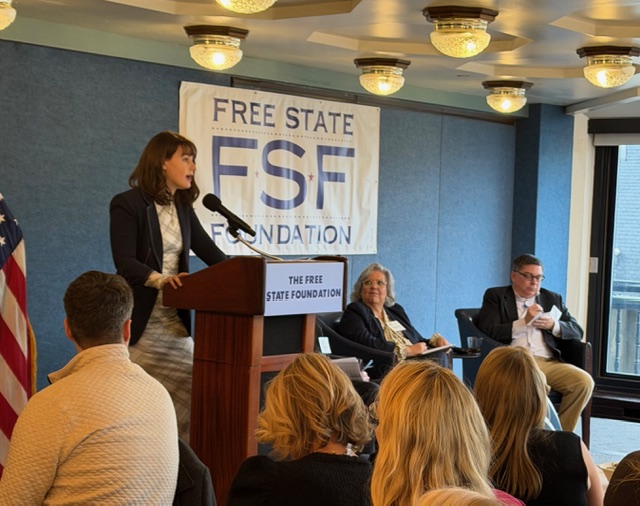
The Free State Foundation luncheon featuring National Telecommunications and Information Administration (NTIA) Administrator Arielle Roth included some welcome news for businesses, families, and taxpayers. At the December 2, 2025, event at the National Press Club, which included comments and questions from former Federal Communications Commissioner Michael O’Rielly and Citizens Against Government Waste (CAGW) Vice President for Policy and Government Affairs Deb Collier, Administrator Roth said that $21 billion will be saved out of the original $42.45 billion for the Broadband Equity Access and Deployment (BEAD) program.
Citizens Against Government Waste has been closely following the BEAD program since it was included in the Infrastructure Investment and Jobs Act. In February 2025, CAGW called for the Trump administration to revise the Biden administration’s faulty and non-statutory guidance that was not technology neutral and included onerous requirements that discouraged many providers from participating in the program. The “benefit of the bargain” revisions that NTIA released on June 6, 2025, addressed many of CAGW’s concerns by removing restrictive and burdensome non-statutory requirements and gave states the flexibility they needed to connect unserved and underserved communities.
In her remarks, Administrator Roth detailed several examples of states using the revised guidance to save taxpayer dollars while expanding the participation of private sector providers. Louisiana was able to use the benefit of the bargain, as well as a technology neutral approach to service providers to lower the costs to connect more than 127,000 unserved and underserved locations from $120,000 under the initial plan filed during the Biden administration to just over $7,000 per location. The total cost is now around $500 million, $220 million less than the original Biden approved plan, and more than $850 million below its original BEAD allocation.
The expanded technology options in the new guidance also encouraged more private sector providers to participate in the benefit of the bargain round. Participants in Arizona and Virginia increased by 40 percent and 50 percent respectively.
In addition to the 20 approvals for state final proposals announced in November, Administrator Roth announced nine new approvals in Arizona, Colorado, Indiana, Michigan, Nebraska, New Jersey, Ohio, South Dakota, and Wisconsin.
The use of the $21 billion in savings has not been determined. Administrator Roth said that the NTIA will provide guidance on how the funds could be used in early 2026. CAGW has suggested that the “BEAD bonus” should be returned to the taxpayers. Michael O’Rielly agrees with that outcome, and added that if the Trump administration does not want all of the excess funds to be returned, they should be spent in line with BEAD’s “central mission.
The updated BEAD guidance has moved the needle forward to get unserved and underserved communities connected and helped save taxpayer funds, making this a win for the entire country. As Free State Foundation President Randy May said, when the history of broadband deployment is written, Administrator Roth and the Trump administration will get a lot of well-deserved credit for making it happen efficiently and with savings for taxpayers.
