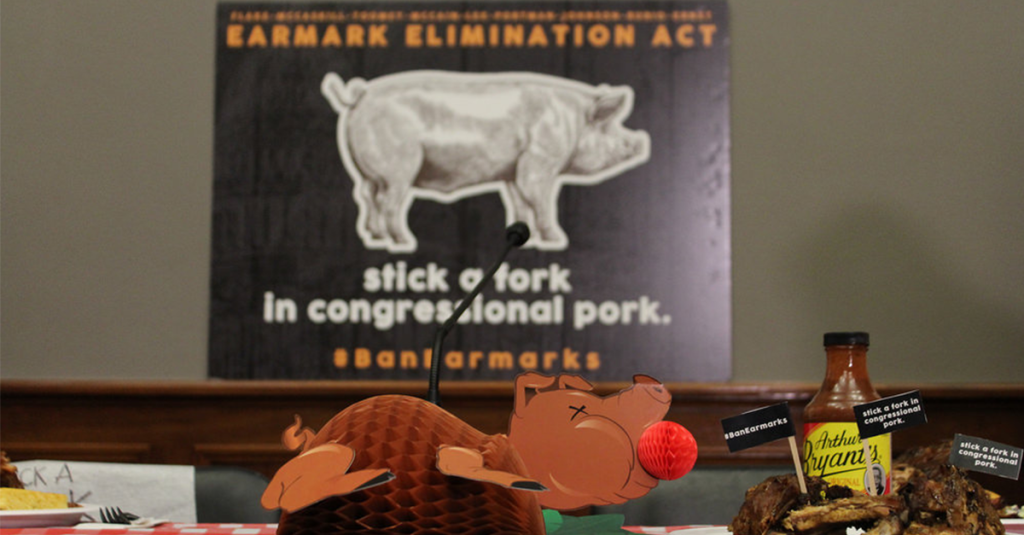
Reality: Earmarks are not the answer to mitigating the extreme partisanship that exists in Washington and are have nothing to do with getting things done.
Connecticut and Pennsylvania Pass Budgets
As we finish our Halloween candy and start preparing for Thanksgiving, each of the fifty states has now passed its required budget. As forty-nine of the fifty states require a balanced budget, which means the politicians can’t always resort to gimmicks and kick the can down the road like they do in Washington, D.C., the […]
Connecticut Legislature Passes a Bipartisan Budget Plan
Faced with a budget deficit of $3.5 billion over the next two years, and three months overdue on a budget for fiscal years 2018 and 2019, Connecticut lawmakers face a difficult situation and must make tough choices. In 2011 and 2015, the legislature tried to solve the state’s fiscal woes by passing big tax increases. […]
The Can-Kicking Congress: Business as Usual
In political patois, “kicking the can down the road” connotes procrastination. As long as the proverbial can is kicked “down the road,” rather than picked up, then the proper disposition of the derelict container is put off until some future point in time. And much like the (equally proverbial) kicker’s aversion to taking definitive action on a relatively straightforward task, the U.S. Congress is composed of 535 “can kickers,” given their predilection to avoid taking action until the last possible minute. On Tuesday, September 5, 2017, when the current Congress reconvenes after its annual August recess, it will have less than a month to complete several “must pass” items.
Debt Ceiling: A Good Vehicle for Budget Process Reform
On March 7, 2017, the Congressional Budget Office (CBO) announced that if the debt ceiling was not raised or extended before March 16, the U.S. Treasury would be unable to borrow funds for standard operating procedures. Since then, the Treasury has been forced to use accounting maneuvers known as “extraordinary measures” to keep the government running, but these work-arounds will only delay the inevitable debate that Congress must have. Eventually, Congress will have to decide how to address the debt ceiling, or the federal government will default on its payments and risk an economic crisis.
We Won’t Always Have Paris
Yesterday, President Donald Trump withdrew from the Paris Climate Treaty or, as it is often called, the Paris Accord. He righted what has been a bone of contention since the agreement’s birth at the Paris climate change meeting in November 2015. Many senators and policy analysts have rightfully argued the climate agreement was a treaty and should have been submitted to the Senate for advice and consent, as the Constitution requires. But, President Obama did not want to submit it to the Senate because he knew it would not be ratified. Instead, he continued his executive overreach and implemented the policy illegally with his “pen and his phone.” Chris Horner and Marlo Lewis of the Competitive Enterprise Institute discuss in their May 2017 report the serious legal and economic consequences to the U.S. if President Obama’s actions were not reversed.
Making Unauthorized Spending Wrong Again
As President Donald J. Trump continues his campaign to “Make America Great Again,” Citizens Against Government Waste (CAGW) will borrow on that theme, as described in the title of this article, by continuing to advocate for reforms of the way that Congress does business. One of the best efforts in this regard is H.R. 2174, Republican Conference Chair Cathy McMorris Rodgers’ (R-Wash.) Unauthorized Spending Accountability (USA) Act, which she introduced on April 26, 2017.
Making the Case for Dynamic Scoring
When Congress considers legislation to lower taxes, the Congressional Budget Office (CBO) will be using dynamic scoring to help estimate its cost. In 2015, Congress required CBO to use dynamic scoring on legislation with an impact of at least 0.25% of gross domestic product over the next 10 years (about $45 billion in 2015), or […]
NFL Hits the Taxpayer-Funding Jackpot in Vegas
Las Vegas has long been known as “Sin City,” and it will soon be home to one of the worst fiscal sins of all time. On October 14, 2016, the Nevada state legislature approved the largest taxpayer subsidy in American sports history. As long as the NFL allowed the Oakland Raiders to move to Las Vegas, taxpayers would fork over $750 million to help fund a new $1.9 billion stadium adjacent to the Vegas strip. On March 27, 2017, NFL owners did just that, approving the move by a vote of 31-1.
Waste Abounds in the Land of the Midnight Sun
On Wednesday, April 5, 2017 the House Natural Resources Subcommittee on Federal Lands held a hearing to consider the construction of a road linking the town of King Cove to Cold Bay, and the latter’s all-weather airport. At issue is H.R. 218, introduced by Federal Lands Subcommittee member Don Young (R-Alaska) in January 2017, which […]